Tuesday
6PM Welcome Reception
6:30PM Film Screening & Panel
7:45PM Reception with Hors d’oeuvres
108 Severn Avenue
Annapolis, MD 21403
You’re Invited to Join Us!
Through the learnings and experiences from Dr. Thomas Lovejoy in tandem with the alarming state of our planet, it has become more than apparent that climate change is happening, and the time to act is now. Artists, activists, scientists, and innovators all have a critical role to play in tackling our shared environmental challenges, but we know this progress won’t happen on its own. With uncertain times ahead, dedicated, innovative leadership must bring together a new, diverse coalition of changemakers.
Biodiversity has not been a principal component in the discussion about Chesapeake Bay restoration in the past, but it should be in the future. The goal of this screening and panel discussion is to elevate the importance of biodiversity in restoring the bay, and to spark action in those who can help combat the negative impacts of climate change on the Chesapeake Bay!
Learn More
A Complex Problem Requires Manifold Solutions
46,300 species are currently threatened with extinction. The plastic in our oceans could outweigh the fish in just 25 years. Global CO2 emissions were 182 times higher in 2022 than they were in 1850, the time the Industrial Revolution began.
As many as 3.6 billion people live in areas of high vulnerability to climate change impacts such as droughts, heat waves, and sea-level rise. Yet, 14% of Americans say there is no solid evidence that climate change is happening. The mass action needed to begin to address these issues remains, largely, at a standstill.
The Godfather of Biodiversity, Ahead of His Time
On Christmas Day 2021, the world lost a legend who deeply understood the complexity of the enormous issue known as climate change. Biologist and conservationist Dr. Thomas E. Lovejoy had a vision to address our environmental crisis, a plan guided by optimism, community, and deep knowledge cultivated through years of research, consensus-building, and commitment to our shared planet.
A founder of the field of conservation biology with E.O. Wilson (1929-2021), Tom (1941-2021) is known as the “Godfather of Biodiversity.” Tom first traveled to the Amazon, the single largest repository of biodiversity on earth, in 1965, through his work with the World Wildlife Fund, for what was slated to be a two-year job. Tom quickly fell in love with “the lungs of the planet,” as the Amazon rainforest is often called due to its incredible ability to store billions of tons of carbon dioxide, thereby helping to stabilize the climate. He ended up staying for 14 years, building and growing a network of scientific outposts, including Camp 41, the site now home to the longest-running scientific research station in the Amazon. Camp 41 is where Tom made the discovery that remained at the core of his research throughout his career: the tipping point of 4-degrees widely touted as the increase that would trigger catastrophe for species across the planet was wrong. Just a 1.5-degree increase would induce these crises. Sadly, Tom’s warning is beginning to play out: recent research shows a tragic shift in the Amazon due to global warming and deforestation, from an absorber of carbon to a source of emissions. Earth’s lungs are faltering.
Despite this dire potential future, Tom always maintained a spirit of optimism and hope: he maintained that by changing the foundations of our infrastructure–energy, food systems, land use, transportation, and consumption–global warming and its ensuing destabilization can be altered. And he believed that the world’s young people must lead that charge.
The Journey Begins, Again: Back to Camp 41
It was in Tom’s spirit of community that George Chmael II and Greg Hemmings were invited by Tom’s family to join the 2022 trip to Camp 41 to scatter the scientist’s ashes throughout the camp and surrounding forests and rivers. George, CEO of Council Fire, a global sustainability consultancy, and board chair of SustainaFest, joined the trip at the request of Tom’s family and brought Greg and a small team of filmmakers to capture the occasion on film for the family and future generations.
The documentary film Back to Camp 41 is a result of this trip. Back to Camp 41 brings viewers along as Tom’s family, friends, and colleagues make the long journey into the Amazon to reach the camp, learn about the environment Tom dedicated his life to observing, and engage with plants and animals that are the very definition of “biodiversity.”
As George, Greg, and Tom’s family worked together in the editing room after returning from the Amazon, it became clear that this project was meant to be more than a poignant remembrance of Tom and his work. Back to Camp 41 is an educational tool: a visual description of the fragmentation Tom studied and an indicator of the warnings around global warming that his research suggests, both rooted in optimism and inspiration. Tom’s work and legacy lives on through the material, and it is honored by the meaningful conversations that stem from his learnings and experiences that are sparking curiosity about biodiversity and ecological fragmentation and igniting the passion for climate action.
Meet the Panelists
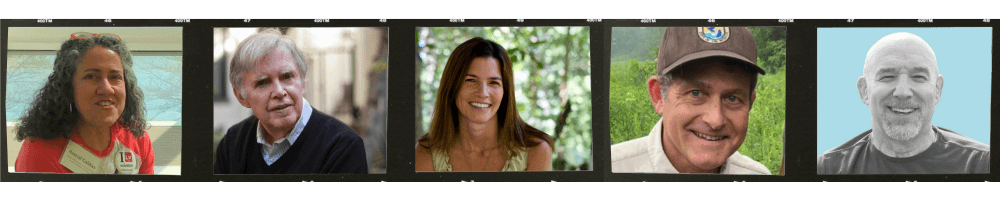
Moderator: Astrid Caldas - Senior Climate Scientist
Astrid Caldas is the senior climate scientist for community resilience at the Climate & Energy program of the Union of Concerned Scientists, working on equitable climate change adaptation and resilience measures with practical policy implications for ecosystems, the economy, and society, also focusing on science communication to various audiences and media outlets. Before joining UCS, Dr. Caldas was a Science & Technology Policy Fellow at the American Association for the Advancement of Science, a Climate Change and Wildlife Science Fellow at Defenders of Wildlife, and a research scientist at the University of Maryland. Dr. Caldas has advised or consulted on projects with organizations including the Smithsonian Institution and the National Socio-Environmental Synthesis Center. Growing up on the Guanabara Bay in Rio de Janeiro, Brazil, she is “a Bay person.” She moved from Rio de Janeiro to Maryland in 1996, and has been a Chesapeake Bay lover ever since. She is a member of the Board of Trustees at the Chesapeake Bay Trust, a member of the Education, Communication and Outreach Workgroup of the MD Commission on Climate Change, and a previous member of the Energy, Air Quality and Climate Advisory Board of Montgomery County. She works on various projects on coastal adaptation in Maryland. She holds degrees in Entomology, Ecology, and Environmental Management and has been quoted widely, including in The Wall Street Journal, The Washington Post, Time Science, and People Magazine. She has appeared on numerous NPR stations, PBS, CBS, NBC, Fox, CNN, Univisión, and Telemundo. She tweets under the handle @climategeek.
Tony Hiss - Writer, Lecturer, and Consultant
Tony Hiss is the author of 15 books, most recently Rescuing the Planet: Protecting Half the Land to Heal the Earth, now in paperback, and the award-winning The Experience of Place. He was a staff writer at The New Yorker magazine for 30 years and a visiting scholar at New York University for 25 years; he has lectured around the world and is a consultant on planning, place, biodiversity, and conservation issues. He lives in New York City with his wife.
Paula J. Ehrlich - President and CEO, E.O. Wilson Biodiversity Foundation
Paula J. Ehrlich, DVM, PhD, is President & CEO of the E.O. Wilson Biodiversity Foundation, whose mission is to reimagine the way we care for our planet through actionable scientific research that supports communities in their stewardship of biodiversity. Dr. Ehrlich is co-Founder of the Half-Earth Project, which is working to inspire informed collective action to save the biosphere and ensure we leave no species behind. Dr. Ehrlich has led the development of the Half-Earth Project Map, a global, spatially-explicit, and taxonomically comprehensive map of species, which informs how well conserved places are protecting species and identifies priorities for future conservation. She is founder of Half-Earth Day, which brings together world-wide participants from across disciplines to share perspectives and thought leadership on how to achieve Half-Earth and ensure the health of our planet for future generations. Dr. Ehrlich has over 30 years of strategic scientific management and research expertise, and diverse academic, non-profit, and corporate leadership experience. Her current work embodies the hopes of the greatest naturalist of our time, E.O. Wilson.
Mike Slattery - Landscape Conservation Coordinator, US Fish & Wildlife Service
Mike Slattery is the Regional Landscape Conservation Coordinator for the U.S. Fish and Wildlife Service’s Northeast Region. He serves in this role as part of the Service’s Science Applications Program, leading landscape conservation partnerships and grant programs in the Northeastern U.S., including the Chesapeake Bay watershed. Prior to joining the USFWS Science Applications Program in 2010, he was the Director of the Eastern Partnership Office for the National Fish and Wildlife Foundation, where he was responsible conservation grant making and financing activities across a 24-state region extending from Maine to Texas. During a 35+ year career as a conservation professional, he has also served as Assistant Secretary for Forests, Parks, Fish and Wildlife at the Maryland Department of Natural Resources; Director of Maryland DNR’s Wildlife and Heritage Service; Director of the Maryland Natural Heritage Program; and Director of the Maryland Nontidal Wetlands and Waterways Permit Program.
George Chmael II - CEO, Council Fire & Board Chair, Sustainafest
Driven by the belief that businesses should prioritize financial, environmental, and social success, George transitioned from corporate law to social entrepreneurship. He founded Council Fire, an award-winning global change agency helping organizations achieve sustainable success. Simultaneously, George understood the power of storytelling in the effort to drive action on the world’s biggest challenges. So, in addition to building a world class team of storytellers at Council Fire, he launched SustainaFest in 2014 with a focus on propelling global progress by curating authentic, science-based narratives that inspire action toward a sustainable and equitable future for all. Through storytelling and strategic collaborations, George and his team at SustainaFest are engaging with diverse communities to accelerate systemic change and have begun doing so through the production and distribution of the film Back to Camp 41.
Want to join the waitlist?
Email events@cbtrust.org.